.png)


Capocollo di Martina Franca: The Ultimate Guide to Puglia’s Famous Cured Meat
Updated: Sep 11
Hidden among the rolling hills, dry-stone walls and ancient masserie of the Itria Valley is another extraordinary expression of Puglia’s culinary heritage: Capocollo di Martina Franca.
Produced primarily around Martina Franca, Cisternino and Locorotondo, Capocollo di Martina Franca is a traditional cured pork meat known for its delicate texture, deep aroma and distinctive lightly smoked flavour.
But this is much more than simply another Italian salume.
Its character is closely connected to the landscape of the Valle d’Itria, its climate, its woods and generations of local norcini, artisans who have preserved the traditional techniques of curing pork.
For travellers interested in discovering traditional Apulian food, Capocollo di Martina Franca is one of the flavours that should not be missed.
What Is Capocollo di Martina Franca?
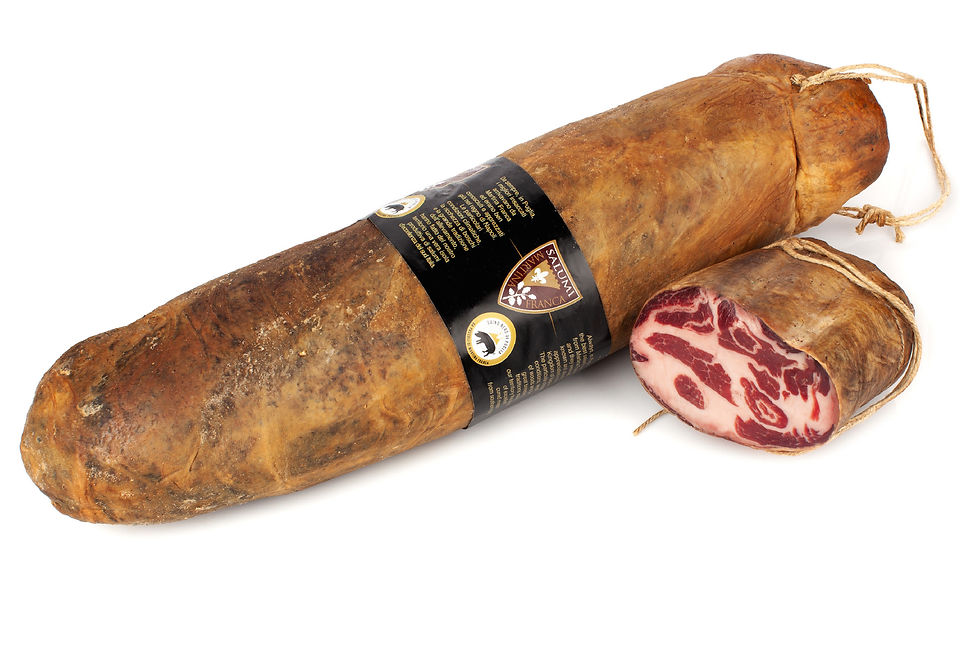
Capocollo di Martina Franca is a traditional Italian cured meat made from the muscular portion located between the neck and shoulder of the pig.
The name itself gives us a clue.
In Italian, capo means “head” and collo means “neck”, referring to the area from which this particular cut is obtained.
Different versions of capocollo, sometimes known as coppa, are produced throughout Italy.
The version made in the Valle d’Itria, however, has developed its own distinctive identity.
Here, the meat is traditionally salted and seasoned before undergoing a curing process that includes the use of wine and a delicate smoking stage.
The result is a cured meat with an intense wine-red colour, white marbling and a soft texture, combining savoury, aromatic and subtly smoky notes.
It is officially recognised among Puglia's Prodotti Agroalimentari Tradizionali (PAT), or Traditional Agri-Food Products, and has been included in Italy's national PAT list since 2001.
Its traditional production area is centred on the Valle d’Itria, particularly around Martina Franca, Cisternino and Locorotondo.

Where Does Capocollo di Martina Franca Come From?
To understand Capocollo di Martina Franca, you first need to understand the landscape where it was born.
The Valle d’Itria stretches across the central part of Puglia, between the provinces of Bari, Brindisi and Taranto.
It is one of the most recognisable landscapes in southern Italy.
Whitewashed towns rise above hills covered with olive trees and vineyards, while trulli, dry-stone walls and traditional farmhouses appear throughout the countryside.
At the heart of this area is Martina Franca, an elegant Baroque town that has long been associated with the production of cured meats.
Historically, families living in rural Puglia raised pigs alongside other livestock and preserved meat to ensure that it could be consumed throughout the year.
Before refrigeration existed, salting, drying and smoking were essential techniques.
Over generations, these practical methods developed into a sophisticated local craft.
The particular climatic conditions of the Valle d’Itria, relatively cool, breezy and surrounded by woodland and Mediterranean vegetation, also contributed to the development of local curing traditions.
Capocollo gradually became one of Martina Franca's most celebrated products.
Today it is considered one of the gastronomic symbols of the Valle d’Itria.
A Tradition That Goes Back Centuries
The art of curing pork has deep roots in southern Italy.
In Martina Franca, the local tradition of producing Capocollo has been documented for centuries, with the product already known and appreciated during the period of the Kingdom of Naples.
For rural families, preserving pork was once part of the natural rhythm of agricultural life.
The slaughter of the pig traditionally took place during the colder months and became an important family and community occasion.
Almost every part of the animal was used.
Some cuts were eaten fresh, while others were transformed into sausages, pancetta, soppressata and capocollo.
Nothing was wasted.
This philosophy remains deeply connected to traditional Puglian cuisine, which historically developed around seasonality, preservation and respect for available ingredients.
Capocollo is therefore not simply a luxury product created for modern gastronomy.
It is the refined descendant of an old rural necessity.
How Is Capocollo di Martina Franca Made?
The production of Capocollo di Martina Franca requires time.
And time is one of its most important ingredients.
Traditional production begins with the selection of the muscular cut from the upper neck and shoulder area of the pig.
1. Selecting the Meat
The cut used for capocollo naturally contains a balance between lean meat and fat.
This marbling is extremely important.
During maturation, the fat contributes to the characteristic softness and flavour of the finished product.
2. Salting
The meat is covered with salt and left to rest.
Salting performs several functions: it helps preserve the meat, removes moisture and begins the slow transformation of its flavour and texture.
The precise duration varies according to the size of the cut and the producer's method.
3. Wine and Aromatics
One of the elements traditionally associated with Capocollo di Martina Franca is the use of wine during processing.
Traditional descriptions of the product also refer to vinocotto or cooked wine, which contributes aromatic and slightly acidic notes to the meat.
Pepper and other aromatics may also be used according to the producer's recipe.
Like many traditional foods, small differences exist between individual artisans.
And that is part of its charm.
4. Wrapping and Tying
After seasoning, the capocollo is wrapped and tightly tied.
The characteristic cylindrical shape is created by careful hand-tying, a technique that also helps the meat maintain its structure during maturation.
5. Smoking
This is one of the stages that makes the Martina Franca tradition particularly interesting.
The meat is lightly smoked.
The purpose is not to create the powerful smoky flavour found in some northern European cured meats.
Instead, smoking should add another subtle aromatic layer.
Traditional production is associated with local woods and Mediterranean vegetation found in the Valle d’Itria.
The smoke becomes part of the aroma without overwhelming the flavour of the pork.
6. Maturation
Finally, the capocollo is left to mature.
During this period, moisture gradually leaves the meat while flavours become more concentrated and complex.
The transformation is slow.
When sliced, a properly matured Capocollo di Martina Franca reveals an intense reddish colour crossed by delicate veins of white fat.
What Does Capocollo di Martina Franca Taste Like?
Capocollo di Martina Franca has a surprisingly elegant flavour.
People tasting it for the first time sometimes expect something extremely salty or heavily smoked.
Instead, a good artisan capocollo is usually much more balanced.
The texture is soft and tender, particularly when sliced thinly.
The flavour combines the natural sweetness and richness of pork with salt, wine, seasoning and a gentle smoky aroma.
Its fat melts slightly in the mouth, carrying the aromas and creating a long finish.
The official description of the traditional product highlights its intense wine-red colour, pronounced aroma and fragrant flavour, including the characteristic contribution of vinocotto.
This combination makes Capocollo quite different from many industrial cured meats.
Its flavour is complex without being aggressive.
Capocollo vs Coppa: What Is the Difference?
Visitors to Italy often encounter both capocollo and coppa and wonder whether they are the same thing.
Essentially, both terms refer to cured meats produced from a similar anatomical area of the pig.
However, Italian salumi traditions are intensely regional.
The ingredients, seasoning, curing techniques, climate and smoking methods can vary considerably from one region to another.
Capocollo di Martina Franca belongs specifically to the culinary tradition of the Valle d’Itria in Puglia.
Its identity therefore comes not simply from the cut of meat, but from the way that cut has traditionally been processed in this particular territory.
This concept is fundamental to understanding Italian food.
The same basic ingredient can become a completely different product depending on the village, landscape and traditions surrounding it.
How Do Puglians Eat Capocollo?
The best way to appreciate Capocollo di Martina Franca is often the simplest.
Cut into very thin slices and eat it at room temperature.
Allowing the meat to warm slightly helps release its aromas and softens the fat.
In Puglia, capocollo can form part of an antipasto, alongside local cheeses, vegetables preserved in olive oil and traditional bread.
A beautiful Puglian tasting board might include:
The combination gives you a small portrait of the region's food culture on a single table.

Capocollo and Fresh Figs
One of the most delicious ways to eat capocollo during the Puglian summer is with fresh figs.
It is an extraordinarily simple combination.
The sweetness and soft texture of ripe figs contrast beautifully with the saltiness, fat and delicate smoky flavour of the cured meat.
No elaborate preparation is required.
A few thin slices of Capocollo di Martina Franca, ripe figs and perhaps some good bread are enough.
This simplicity represents something essential about traditional Puglian cuisine: exceptional ingredients rarely need complicated recipes.
What Wine Goes with Capocollo di Martina Franca?
Wine is a natural companion to cured meats, and Puglia offers plenty of options.
A medium-bodied red wine can work beautifully with Capocollo, particularly wines made from indigenous Puglian grapes.
Depending on your preference, you might try:
Primitivo: rich and fruit-forward, particularly suitable if the capocollo is served with aged cheeses.
Negroamaro: structured and slightly more savoury, providing an interesting contrast to the richness of the pork.
Susumaniello: another native Puglian grape that can offer freshness and dark-fruit aromas.
You do not necessarily need a powerful wine.
Because good Capocollo di Martina Franca can be surprisingly delicate, the goal should be balance rather than overpowering the meat.
Capocollo and the Food Culture of the Valle d’Itria
Capocollo makes even more sense when considered alongside the other foods of the Valle d’Itria.
This area is famous for its relationship with meat.
Travel through towns such as Martina Franca, Cisternino and Locorotondo and you will encounter the tradition of the fornello pronto.
These are butcher shops where customers select meat directly from the counter and have it cooked immediately, traditionally in a wood-fired or charcoal oven.
Among the most famous specialities are bombette, small rolls of pork filled with cheese and other ingredients.
Alongside them you might find sausages, gnummareddi and different cuts of meat prepared according to local traditions.
Capocollo belongs to this same culinary world.
Together, these foods reveal a part of Puglia that visitors who associate the region exclusively with seafood and pasta sometimes overlook.
Puglia is not one cuisine.
It is a mosaic of local cuisines.
And the Valle d’Itria has a gastronomic identity all of its own.
Discover Puglia Throught Its Food
Is Capocollo di Martina Franca a Protected Traditional Product?
Yes, Capocollo di Martina Franca is officially included among Italy's Prodotti Agroalimentari Tradizionali (PAT).
PAT status identifies foods whose traditional methods of processing, preservation and maturation have been established within a particular territory over time.
Capocollo di Martina Franca entered the national PAT list in 2001.
The officially identified traditional area includes the Valle d’Itria and particularly the municipalities of Martina Franca, Cisternino and Locorotondo.
This recognition is important because it confirms that Capocollo is not simply a commercial name.
It represents a documented food tradition connected to a specific part of Puglia.
Where Can You Try Capocollo di Martina Franca?
If you are travelling through Puglia, the best place to discover Capocollo is naturally the
Valle d’Itria.
Martina Franca should be your first stop.
The town itself deserves a visit, with its Baroque architecture, narrow streets and elegant historic centre.
Traditional butcher shops, delicatessens and specialist food stores around the Valle d’Itria often sell locally produced capocollo.
You can also encounter it on antipasti served in restaurants, trattorie and masserie.
Nearby towns such as Cisternino and Locorotondo offer further opportunities to explore the meat traditions of the area.
But rather than simply buying a package from a supermarket, look for an artisan producer.
Ask where the meat was made.
Ask how long it was matured.
Ask about the smoking process.
Food becomes much more interesting when you know the people and traditions behind it.
What to Look for When Buying Capocollo
When choosing Capocollo di Martina Franca, appearance can tell you quite a lot.
Once sliced, the meat should have a deep reddish or wine-red colour with visible white fat distributed through the cut.
The aroma should be pronounced but pleasant.
Smoking should be noticeable without dominating everything else.
Texture is equally important.
Capocollo should not feel excessively dry or rubbery.
Thin slices should remain tender, with fat that begins to soften at room temperature.
Whenever possible, buy from artisan producers or specialist shops that can explain where and how their capocollo was made.
Why Capocollo Is One of the Foods You Should Try in Puglia
There are certain foods that help you understand a destination.
Capocollo di Martina Franca is one of them.
Eating it tells you something about the geography of the Valle d’Itria, where hills and woodland replace the coastal landscape many visitors associate with Puglia.
It tells you something about rural life, when families needed to preserve meat through the winter.
It tells you about craftsmanship, patience and the ability to transform a simple cut of pork through salt, wine, smoke and time.
And perhaps most importantly, it demonstrates why Puglian cuisine cannot be reduced to a handful of famous dishes.
Orecchiette, burrata and focaccia may be the foods travellers recognise first.
But the deeper you explore Puglia, the more local traditions you discover.
Capocollo di Martina Franca is one of those discoveries.
Discover Traditional Food in Puglia
Food is one of the best ways to understand Puglia.
Every part of the region has its own recipes, ingredients and traditions shaped by agriculture, landscape and generations of family knowledge.
In Bari, you encounter focaccia and orecchiette.
Around Andria, burrata has become one of Puglia's most internationally recognised products.
In the Valle d’Itria, meat traditions such as Capocollo di Martina Franca and bombette become part of the landscape.
Along the coast, seafood takes centre stage.
Travel south and the cuisine changes again.
This extraordinary variety is what makes exploring traditional Apulian food so fascinating.
Rather than simply tasting individual dishes, try to understand where they come from.
Visit markets.
Meet local producers.
Eat in masserie.
Discover the ingredients that families in Puglia have used for generations.
Because food here is not simply something to eat.
It is one of the ways Puglia tells its story.
Want To Taste The Authentic Puglia?
Join us and discover Puglia through its food, traditions and local people
Frequently Asked Questions About Capocollo di Martina Franca
What is Capocollo di Martina Franca?
Capocollo di Martina Franca is a traditional Puglian cured pork meat produced in the Valle d’Itria, particularly around Martina Franca, Cisternino and Locorotondo. It is made from the neck and upper shoulder area of the pig and traditionally undergoes salting, seasoning, light smoking and maturation.
What does Capocollo di Martina Franca taste like?
It has a rich but balanced flavour with savoury, aromatic and slightly smoky notes. The meat is tender, while its natural fat gives it a soft texture and long flavour.
Is Capocollo di Martina Franca smoked?
Yes. Light smoking is one of the characteristic elements of the traditional production process. The objective is to add aroma rather than create an overpoweringly smoky flavour.
Where is Capocollo di Martina Franca produced?
Its traditional production area is the Valle d’Itria in Puglia, particularly around Martina Franca, Cisternino and Locorotondo.
Is Capocollo di Martina Franca a PAT product?
Yes. Capocollo di Martina Franca has been included in Italy's national list of Traditional Agri-Food Products (PAT) since 2001.
How should Capocollo di Martina Franca be served?
It is best sliced thinly and served at room temperature. It can be enjoyed on its own or as part of a Puglian antipasto with cheeses, bread, olives and vegetables. Fresh figs are an excellent seasonal pairing.
What wine goes with Capocollo?
Puglian wines such as Primitivo, Negroamaro or Susumaniello can pair well with capocollo, depending on the other foods being served.
A Taste of the Real Puglia
There is a moment when travelling when a destination stops being simply somewhere you visit and starts becoming something you understand.
Food often creates that moment.
A slice of Capocollo di Martina Franca may seem simple: pork, salt, wine, smoke and time.
But behind those ingredients lies the landscape of the Valle d’Itria, centuries of rural knowledge and generations of artisans.
That is why tasting traditional food matters.
It connects you to the people and places behind what is on your plate.
And if you want to discover the real Puglia, sometimes the journey can begin with something as simple as a slice of capocollo.
An Artisanal Cured Meat Recognized by Slow Food
Capocollo di Martina Franca is a Slow Food Presidium, guaranteeing quality, sustainability, and traditional production methods. Farmers use pork from locally raised pigs, often crossbred with the native Nero di Martina Franca breed, and adhere to strict production guidelines.
This salume is a true excellence among traditional Apulian food products, made using techniques passed down through generations.
How to Enjoy Capocollo di Martina Franca
Capocollo is incredibly versatile and ideal for:
Traditional Apulian appetizers, served with Altamura bread and regional cheeses
Charcuterie boards featuring artisanal cured meats
Gourmet pairings with fresh figs, honey, or fruit preserves
Rustic sandwiches with extra virgin olive oil and cherry tomatoes
Pair it with a glass of Primitivo di Manduria or Negroamaro wine for a full Apulian tasting experience.

Where to Buy Capocollo di Martina Franca
You can find this product in:
Traditional delicatessens in Martina Franca, Locorotondo, Cisternino, and Alberobello
Local food markets and food fairs in Puglia
Online shops specializing in Apulian products, preferably certified by Slow Food
Always choose artisan-quality Capocollo with clear labeling and certified origins for the best experience.
Why Choose Capocollo di Martina Franca
Choosing Capocollo di Martina Franca means bringing an authentic, high-quality product to your table, rich in history and deeply connected to its land of origin. It's one of the best expressions of traditional cured meats from Puglia, perfect for those who value flavor, authenticity, and craftsmanship.
Related Articles
Traditional Pasta of Puglia
Written by: Senti La Puglia
(Fabiano Semeraro & Silvia Calamo
Local hosts passionate
about preserving Puglia’s traditions
through authentic cultural experiences.)


Comments